

GPR (Ground Penetrating Radar)
ELECTROMAGNETIC METHODS
GPR (Ground Penetrating Radar)

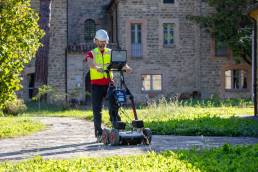
Georadar, or GPR (Ground Penetrating Radar), is a noninvasive geophysical survey technology used for subsurface exploration and structure diagnostics.
The method is based on the emission of radio-frequency electromagnetic pulses by a transmitting antenna. As these waves pass through materials, they are partially reflected and diffracted at physical discontinuities (changes in dielectric constant or electrical conductivity) and detected by a receiving antenna. By analyzing the time and intensity of the reflected signal, information on the nature, depth, and geometry of the objects or layers passed through can be obtained.
Fields of Application:
Subsurface detection
Inspection of tunnels
Mapping of archaeological sites
Detection of cavities
Environmental surveys: detection of landfills, contaminated sites, and buried drums
Detection of unexploded ordnance
Fields of Application:
Subsurface detection
Inspection of tunnels
Mapping of archaeological sites
Detection of cavities
Environmental surveys: detection of landfills, contaminated sites, and buried drums
Detection of unexploded ordnance
Discover the other electromagnetic methods
We are able to offer our partners multiple solutions in the field of Electromagnetic Investigations. Discover how we can meet your needs.

Frequency-domain Electromagnetic method (FDEM)
ELECTROMAGNETIC METHODS
Frequency-domain Electromagnetic method (FDEM)

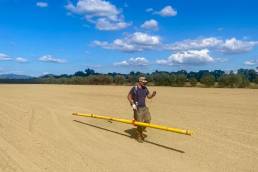
The Frequency Domain Electromagnetic (FDEM) method is a noninvasive geophysical technique for analyzing the electrical and magnetic properties of the subsurface through electromagnetic induction.
The system consists of two coils: a transmitter (Tx), which generates an alternating electromagnetic field of known frequency, and a receiver (Rx), which measures the ground response. When the primary field passes through the ground, it induces electric currents in the conductive materials. These currents, in turn, generate a secondary field, the intensity of which depends on the electrical conductivity of the medium.
The method allows two components to be measured:
- The quadrature component, used to calculate the apparent electrical conductivity;
- The in-phase component, which is sensitive to magnetic susceptibility and the presence of metallic materials.
FDEM is a rapid technique suitable for detailed mapping of large portions of land.
Fields of Application:
Archaeological research
Contaminant mapping
Hydrogeological research
Metal object search
Fields of Application:
Archaeological research
Contaminant mapping
Hydrogeological research
Metal object search
Discover the other electromagnetic methods
We are able to offer our partners multiple solutions in the field of Electromagnetic Investigations. Discover how we can meet your needs.
Magnetotelluric (MT) Audio Magnetotellutic (AMT)
ELECTROMAGNETIC METHODS
Magnetotelluric (MT) Audio Magnetotellutic (AMT)

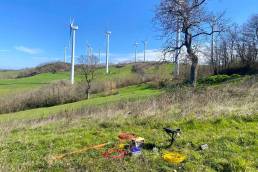
The magnetotelluric (MT) and audiomagnetotelluric (AMT) methods are based on the analysis of natural variations in electric and magnetic fields measured at the surface, generated by phenomena such as the interaction of the solar wind with the Earth's magnetosphere and global thunderstorm activity.
These electromagnetic variations, which propagate into the Earth’s interior, allow investigation of the distribution of electrical properties (resistivity) in subsurface materials. The classical magnetotelluric (MT) survey is mainly used for studies at great depths, due to the ability of low-frequency waves to penetrate up to tens of kilometers.
Its high-frequency variant, known as audiomagnetotelluric (AMT), on the other hand, allows for greater resolution at shallower depths, generally between a few hundred meters and a few tens of meters. The high depth of investigation, combined with the absence of artificial sources and virtually zero environmental impact, makes the MT-AMT method an extremely effective and noninvasive tool for geophysical exploration in both regional and local settings.
Fields of Application:
Regional and local mineral exploration
Geothermal prospecting
Large-scale geological studies
Hydrogeological research
Fields of Application:
Regional and local mineral exploration
Geothermal prospecting
Large-scale geological studies
Hydrogeological research
Discover the other electromagnetic methods
We are able to offer our partners multiple solutions in the field of Electromagnetic Investigations. Discover how we can meet your needs.