

Tests on masonry

Single flat jacks technique
The test aims to estimate the state of compressive stress acting on a portion of masonry at the time of the test. The investigation consists of making a plane cut, perpendicular to the direction of the main tensile stress of the masonry, into which the flat jack is inserted. The flat jack is then connected to a hydraulic pump circuit. The internal surfaces of the cut will be subjected to a known pressure, gradually increased, which allows for the restoration of the initial condition, that is, the nullification of the deformation measured after the cut is made. This deformation is recorded through relative distance measurements between pairs of homologous points symmetrically positioned with respect to the cut.
Reference standards: ASTM C 1196 – 09 and ASTM C 1197 – 04.

Double flat jacks technique
The test aims to estimate the deformability (and/or rupture) value of a portion of masonry situated between two flat jacks. The test consists of making two parallel plane cuts at a known distance apart, into which two flat jacks are inserted and connected to a hydraulic pump circuit. The masonry portion under examination is subjected to loading and unloading cycles, and the deformation is measured using at least three displacement transducers arranged vertically and symmetrically around the midpoint between the two flat jacks. This allows for the determination of the elastic modulus, the load/deformation curve, and the rupture stress of the structure under investigation.
Reference standards: ASTM C 1196 – 09 and ASTM C 1197 – 04.

Video-endoscopic investigations
The visual examination with an endoscope allows for a direct visual inspection of the consistency and nature of the material in the investigated masonry section, with the identification of any anomalies. The endoscopic probe consists of an optical group with a light source at the tip, which transmits the images via cable to a monitor. These images can be stored both as videos and as photographs, from which more details can be extracted during interpretation on a PC.

Thermographic inspections
Thermographic inspection is a non-destructive technique that can examine only the surface layers of a structure by detecting infrared radiation emitted or reflected by objects. It is through the varying thermal conductivity and inertia of the deeper building elements that the thermal camera can map the temperature on the surface. The result is an image in a color or grayscale scale, corresponding to a temperature range on the order of fractions of a degree Celsius, allowing for the discrimination of different material compositions or types. The detection is carried out without any contact with the surface of the analyzed structure. Reference standard: UNI 10824-1/2000.

Masonry core drilling
The continuous coring test is a type of mechanical survey that involves extracting material from the investigated structural element. This type of investigation allows for the direct observation of the sample, enabling the stratigraphy of the masonry to be determined and identifying any anomalies and discontinuities within it. Core drilling can be performed both to analyze the internal composition of the masonry and to assess the depth of the foundation level of the investigated structure.
Reference standard: UNI EN 12504-1.
Tests on concrete

Rebar scanners
The magnetometric test (using a covermeter) allows for the detection of reinforcement bars within reinforced concrete structural elements, the measurement of cover thickness, and an estimate of the diameter of the bars. The technique is based on the principle of magnetic induction, as the localization of reinforcement bars is made possible due to the magnetic properties of steel. Reference standard: BS 1881-204/1988.

Sclerometric test
The sclerometric test is a non-destructive testing method used to obtain information about the quality and homogeneity of concrete by measuring the surface hardness of the material. The test involves measuring the rebound height of a conventional mass launched with constant kinetic energy against the surface of the concrete structural element being examined, using a spring of known stiffness. The rebound index IrI_rIr is proportional to the surface hardness of the concrete. Reference standard: UNI EN 12504-2/2012.

Concrete core drilling
The in-situ sampling of concrete is carried out through continuous coring in the concrete using a core drill, either manual or automatic. The aim is to enable the physical, chemical, and mechanical characterization of the extracted sample. Reference standards: UNI EN 12390-3/2009, UNI EN 12504-1/2009.

Ultrasonic test
The aim of the ultrasonic test is to determine the speed of propagation of ultrasound in concrete, which is directly correlated with its compressive strength. The ultrasonic test measures the time it takes for longitudinal elastic waves to propagate between one or more pairs of sampling points, providing information about the homogeneity of the concrete. The equipment consists of a pulse generator/receiver, a transducer, and a calibration bar with a known propagation time. The measurement of the impulse velocity can be carried out in a direct manner (placing the transducer and receiver on opposite faces), in a semi-direct manner (placing the transducer on one surface and the receiver on an adjacent side), or in an indirect manner (placing both the transducer and receiver on the same surface). Reference standards: UNI EN 583-1/2004, UNI EN 12504-4/2005.

Metallic structure sampling
The sampling of metallic structural elements from a reinforced concrete structure allows for their physical, chemical, and mechanical characterization. After identifying the reinforcement bars using a covermeter, the bars are extracted, and subsequent tests are performed to assess yield strength, rupture, elongation, chemical composition, and weldability. Reference standard: UNI EN 10002-1/2004.

Combined SON-REB method
The SONREB method is based on the combination of results obtained through sclerometric and ultrasonic tests, correlating the velocity of ultrasonic waves (SONic), the rebound index (REBound), and the compressive strength of concrete. This provides a more accurate estimate of the condition of the concrete in the investigated area. Reference standards: UNI EN 12504-2/2012 and UNI EN 12504-4/2005.
Metal hardness test
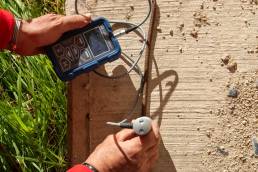
The durometric test aims to estimate the hardness value of steel, from which the tensile strength can be evaluated through direct correlation. The method is based on measuring the energy loss of a body that has been thrown against the object under examination. Reference standards: UNI EN ISO 18265 – DIN 50157.

Pull-out test
The Pull-Out test is a non-destructive method for evaluating the mechanical properties of reinforced concrete. It measures the force required to extract a plug from the reinforced concrete, which can either be pre-embedded in the concrete pour or post-inserted into the hardened concrete. This provides information regarding the cortical layer of the structural element under investigation. Reference standard: UNI EN 12504-3.

Pull-off test
The Pull-Off test aims to verify the adhesion between the substrate and the outer layers of the concrete coating, such as mortars, plasters, waterproofing, etc. The method involves applying an increasing load on the investigated surface until detachment or rupture of the element occurs. This measures the tensile strength and the pull-off resistance of wall coatings made of masonry or concrete. Reference standards: UNI EN 1015-12/2002, ASTM C1538/04, UNI EN 1542/2000, UNI 12636/2001. Reference recommendations for applications with composite materials: CNR-DT 200 R1/2013, C.S.LL.PP. 24 July 2009.

Chemical analysis
Determination of carbonation depth:
The test aims to determine the depth of carbonation starting from the surface layer of the concrete. It can be carried out either on core samples or in situ by chipping away at the structure to be investigated. Normally, concrete has a pH value close to 13, which helps prevent the oxidation of reinforcement within the material. The procedure involves spraying a 1% phenolphthalein solution in ethanol onto the portion of the structure being examined. This helps detect any reduction in pH levels. If the pH value drops below the minimum cover thickness, it may lead to the onset of oxidation phenomena in the reinforcement, signaling potential corrosion risks.
Determination of chloride ion penetration profile in concrete:
The objective of this investigation is to quantify the diffusion of chloride ions within the concrete structural element. The depth of chloride ion penetration is measured by defining the boundary between the penetrated zone and the area that has not yet been contaminated by the ions.
Reference standards: UNI EN 12504-1 and UNI EN 11747.
Special tests

Static load test
Load tests are tests aimed at verifying the stability and strength of the investigated structure. Specifically, the tests subject the structure to the maximum static stress it can tolerate, or at least the maximum stress declared in the design, always within the limits of service actions. This type of investigation can be carried out either with a concentrated load (pulling or pushing) or with a distributed load on newly constructed works or on structures undergoing renovation.

Georadar surveys
The Ground Penetrating Radar (GPR) is a non-invasive subsurface investigation system for shallow depths, based on the reflection of electromagnetic waves. This technique is widely used for locating underground utilities such as road manholes and pipes, for identifying and mapping existing structures, defining the geometric layout of foundations, and detecting walls and cavities.
Short electromagnetic pulses with varying frequencies are emitted into the ground. These pulses encounter different surfaces with distinct physical properties (different dielectric constants or electrical conductivities), and are partially reflected (returning to the receiving antenna) and partially transmitted further into the ground. The maximum depth and the level of detail achievable depend on the frequency used. Lower frequencies allow for deeper penetration, while higher frequencies are preferred for better resolution of shallow targets.
By moving the antenna along a pre-defined straight line (typically creating a regular grid), a radargram is generated in real-time on a PC monitor in digital form, which is then processed and interpreted using specialized software.
Ultrasonic tomography
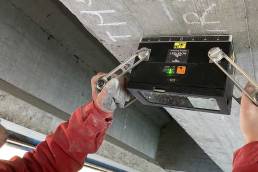
Ultrasonic tomography is a non-invasive technique used to investigate thick concrete elements, such as tunnel linings, post-tensioning ducts, as well as the condition of reinforcement and stone structures. The functioning of the tomograph is based on the reflection of short elastic wave pulses (P or S waves) caused by cracks, cavities, reinforcement, and other discontinuities or anomalies present within the material. The advantage of this type of instrumentation is that it can produce 2D tomographies along a section perpendicular to the surface of the structure, even for structures that are accessible from only one side. By repeating the survey over a regular grid of points, it is possible to generate a 3D model of the internal structure of the investigated element.

Pile integrity test
The Pile Integrity Test (PIT) is performed using a specialized instrument called the Pile Integrity Tester. This type of investigation allows the detection of significant defects within a foundation, such as fractures, significant dimensional variations, and voids, before proceeding with the construction of the superstructure. It can also be used to test piles already integrated into the structure, such as foundation supports for bridges or towers, and assess their length. This method is particularly valuable for ensuring the integrity of piles before heavy loads or additional construction is applied.
Discover the other structural investigations:
We are able to offer our partners multiple solutions in the field of Structural Investigations. Discover how we can meet your needs.