


Other electrical methods
Other electrical methods

Vertical Electrical Sounding
Vertical electrical sounding (or VES) represents a method for investigating the variation of resistivity with depth. This technique involves a series of resistivity measurements to be made with increasing progressive distances between current (A-B) and potential (M-N) electrodes, according to a four-pole device of various types. Current is fed into the ground through the two outer electrodes A and B; the potential difference generated in the subsurface as current passes between A and B is measured through the two middle electrodes M and N. From the measurements of potential difference (ddp) and current intensity (I), the apparent resistivity (R) of the soil is obtained. By increasing the distance between electrodes A-B and M-N, measurements can be extended to deeper and deeper layers. By plotting the apparent resistivity values on a logarithmic diagram, the apparent resistivity curves are constructed from which, with the help of a mathematical model, the values of the actual resistivities and the thickness of the layers with different resistivities can be traced.

Self-Potential Measurements
The Self-Potential method consists of a type of passive geoelectrical survey that allows the measurement, by means of a pair of non-polarizable electrodes, of changes in the electrical potential in the subsurface due to an electric field generated by natural sources (hydraulic, thermal, and chemical). The components of Spontaneous Potential are mainly: Electrokinetic Potential, generated by groundwater flow, and Electrochemical Potential, generated by the difference in solute concentrations as a result of oxide-reduction reaction between water and the rocks with which it comes in contact.
Arc Testing Method to verify the integrity of HDPE sheets
The Arc Testing Method is an electrical investigation methodology for locating “leaks” in exposed geomembranes, as long as they are dry, clean, and do not have excessive ripples that could result in possible shielding of current flow. It is based on the principle of creating a high voltage by means of a probe above the insulating membrane and an electrode outside the investigated area to close the electrical circuit in cases of holes, cuts, or defects in the welds.

OHMEX testing for HDPE sheet integrity
The OHMEX method consists of an electrical investigation for locating “leaks” in HDPE geomembranes buried by a hydraulic headwash or man-made material. It is based on the principle of creating an electric current flow between electrodes placed in contact with the geomembrane and outside the investigated area; respectively, where holes, holes, cuts or defects in welds are present, the electric circuit is closed and high potential values are measured.
Discover the other electrical methods:
We are able to offer our partners multiple solutions in the field of Geoelectrical Investigations. Discover how we can meet your needs.

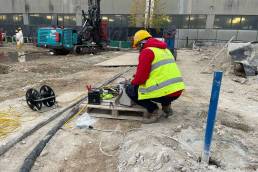
ERT+IP in hole geoelectrics
ELECTRICAL METHODS
ERT+IP in hole geoelectrics

In-hole geoelectric surveys are based on measuring the apparent resistivity and apparent chargeability of the subsurface using electrodes installed inside one or more boreholes.
This methodology makes it possible to obtain a geoelectrical characterization of the subsurface with high vertical resolution, representing a valuable extension of traditional surface ERT/IP surveys, especially in contexts where the stratigraphy is complex or covered by low conductivity materials.
The principle of operation is similar to that of multielectrode surface surveys: data acquisition is by means of a georesistivimeter, which manages the sequential activation of electrodes, installed at different depths along the borehole walls. The holes can be single (for vertical down-hole type measurements) or multiple (for 2D and 3D cross-hole configurations), allowing direct exploration of the investigated volume horizontally and vertically. Electrodes can be temporarily lowered or permanently installed, depending on monitoring needs. Finally, performing repeated measurements over time (timelapse), especially in 3D configuration, is a powerful tool for dynamic monitoring.
Fields of Application:
Electro-stratigraphic reconstruction
Verification of presence or search for aquifers
Study of pollution phenomena in soils or groundwater
Definition of contaminated volumes
Search for hidden cavities
Stratigraphic research
Detection of subsurface leaks
Study of landslides
Mineral prospecting
Fields of Application:
Electro-stratigraphic reconstruction
Verification of presence or search for aquifers
Study of pollution phenomena in soils or groundwater
Definition of contaminated volumes
Search for hidden cavities
Stratigraphic research
Detection of subsurface leaks
Study of landslides
Mineral prospecting
Discover the other electrical methods:
We are able to offer our partners multiple solutions in the field of Geoelectrical Investigations. Discover how we can meet your needs.
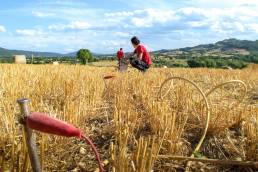
ERT+IP surface geoelectrics
ELECTRICAL METHODS
ERT+IP surface geoelectrics

Geoelectrical methods are based on measuring the apparent resistivity of the soil.
These completely noninvasive investigations provide fundamental information on the lithological nature of soils due to the sensitivity of electrical resistivity to physical parameters such as mineralogical composition, presence of fluids, temperature, porosity, and degree of cementation of the material. An extension of the ERT method is Induced Polarization (IP), a complementary technique that measures the apparent chargeability of soil. After DC injection, the decay of the electrical potential during the discharge phase is recorded, a parameter sensitive to the low-frequency capacitive properties of the materials. These properties are related to electrochemical polarization processes occurring at the interface between grains and fluids in the pores, often influenced by fluid chemistry, lithological variations.
Prospecting is conducted along linear profiles (2D) or on areally distributed grids (3D), by installing equidistant electrodes, connected by a multicore cable connected to a geosurveyor. Finally, taking repeated measurements over time (timelapse), especially in 3D configuration, is a powerful tool for dynamic monitoring.
Fields of Application:
Checking for the presence of structural discontinuities (faults, slip-surfaces, etc.)
Verification of presence or search for groundwater
Study of pollution phenomena in soils or groundwater
Definition of contaminated volumes
Search for hidden cavities
Stratigraphic research
Detection of subsurface leaks
Study of landslides
Mineral prospecting
Fields of Application:
Checking for the presence of structural discontinuities (faults, slip-surfaces, etc.)
Verification of presence or search for groundwater
Study of pollution phenomena in soils or groundwater
Definition of contaminated volumes
Search for hidden cavities
Stratigraphic research
Detection of subsurface leaks
Study of landslides
Mineral prospecting
Discover the other electrical methods:
We are able to offer our partners multiple solutions in the field of Geoelectrical Investigations. Discover how we can meet your needs.